
From clusters to atoms: fragmentation of metal nanoclusters on magnetite
Nanoclusters are made of only a few atoms, yet the bonds holding these atoms together can be remarkably strong. This is one reason why metal clusters are attractive building blocks for catalysts and other advanced materials: their properties depend critically on their size and atomic structure.
But what happens when such a cluster lands on a surface?
A study performed using the x-rays of the SuperESCA beamline has revealed an unexpected answer. Researchers from the University of Trieste, Elettra Sincrotrone Trieste and CNR have found that clusters made of early transition metals such as tungsten, molybdenum and tantalum can spontaneously break apart even when deposited in controlled landing conditions (below the energy threshold for excluding damage to the clusters due to their impact) on the surface of magnetite, Fe₃O₄(100). Remarkably, this happens already at room temperature, without heating and without the need for a reactive gas.
The discovery challenges the intuitive idea that a cluster deposited on a surface simply remains a smaller version of the corresponding metal particle. Instead, the surface itself can profoundly change morphology, structure and stability of the cluster.
The experiments employed clusters containing a precisely controlled number of atoms produced by ENAC (Exact Number of Atoms in each Cluster), the size-selected cluster source developed at the Nanoscale Materials Laboratory. They were deposited onto a carefully prepared magnetite surface and investigated exploiting the high-photon flux and high-resolution X-ray photoelectron spectroscopy (HR-XPS) available at the SuperESCA beamline. The measurements revealed that the atoms initially belonging to the same cluster no longer behave as a compact metallic ensemble. Instead, the clusters fragment into smaller species, depending on their nuclearity, and in some cases into highly dispersed individual atoms which can be identified by means of HR-XPS (see Fig. 1a).
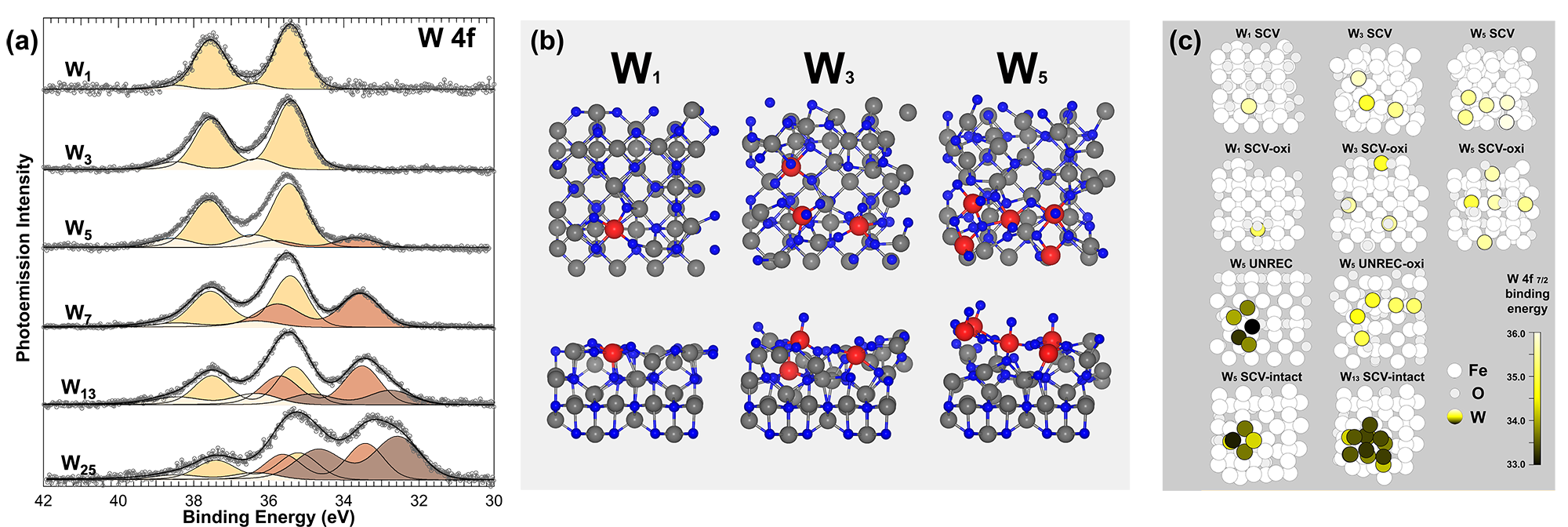
Figure 1: (a) W 4f core level spectra of tungsten clusters composed of different number of atoms and deposited on magnetite. (b) Structural model for W1, W3 and W5 obtained by using DFT. (c) Calculated 4f7/2 core electron binding energies for non-equivalent W atoms.
The effect is particularly striking for tantalum, for which extensive fragmentation is observed immediately after deposition for clusters as large as 25 atoms. Tungsten and molybdenum also undergo fragmentation, although to a progressively lesser extent. The tendency follows the strength with which these metals interact with oxygen.
Why does this happen?
The answer lies in the surface itself. The magnetite surface is not simply a flat arrangement of atoms. Its particular atomic reconstruction contains sites where metal atoms can form very strong bonds with oxygen, as shown in Fig. 1b. For tungsten, molybdenum, and tantalum, these metal–oxygen bonds can be stronger than the bonds holding the metal atoms together.
As a result, when a cluster binds to the magnetite surface, the surface effectively competes with the cluster cohesion. Rather than remaining bonded mainly to their neighbouring metal atoms, some atoms preferentially form strong bonds with the oxygen atoms of the oxide. The cluster can therefore break apart spontaneously, forming single atoms that can be spectroscopically revealed by combining experiments and theoretical calculations (see Fig. 1c).
This process is fundamentally different from the familiar thermal fragmentation of nanoparticles. The metals investigated here normally require being heated up well above room temperature for significant atomic mobility. Yet on the reconstructed magnetite surface, fragmentation occurs at room temperature because the interaction with the support provides a different driving force.
The finding has implications well beyond this particular combination of metals and magnetite. In many practical catalysts, the active material is not an isolated particle but a collection of metal atoms and clusters bonded to an oxide surface. Understanding whether these species remain intact, break apart or become single atoms is therefore essential for understanding how catalysts evolve during operation. The results also point towards a possible strategy for producing highly dispersed metal species. Rather than breaking nanoparticles apart through high-temperature treatments, it may be possible to exploit carefully chosen metal–support interactions to drive their fragmentation spontaneously. More broadly, the work shows that a surface is not merely a passive support. At the atomic scale, it can determine whether a cluster survives, changes its structure or falls apart completely.
This research was conducted by the following research team:
Gabriele Coltrioli1, Deborah Perco1, Luca Sementa2, Andrea Berti1, Mikhail Bandurist1, Marco Bianchi3, Paolo Lacovig3, Silvano Lizzit3, Aras Kartouzian4, Ueli Heiz4, Alessandro Fortunelli5, Alessandro Baraldi1,3
1 Department of Physics, University of Trieste, Trieste, Italy
2 Istituto per i Processi Chimico-Fisici, CNR, Pisa, Italy
3 Elettra - Sincrotrone Trieste S.C.p.A., Trieste, Italy
4 Chemistry Department & Catalysis Research Center, Technical University of Munich, Garching, Germany
5 Istituto di Chimica dei Composti Organometallici, CNR-ICCOM, Pisa, Italy
Reference
G. Coltrioli, D. Perco, L. Sementa, A. Berti, M. Bandurist, M. Bianchi, P. Lacovig, S. Lizzit, A. Kartouzian, U. Heiz, A. Fortunelli, A. Baraldi, “Room-Temperature Adsorption on Magnetite Induces Spontaneous Fragmentation of Early Transition-Metal Size-Selected Nanoclusters", J. Am. Chem. Soc. 148, 41612 (2026); DOI:
10.1021/jacs.6c15419 .
