
Steering electrons in an atomic system by quantum coherent control
Scientists from the Max Born Institute Berlin (Germany), the Université Catholique de Louvain (Belgium), the University of Uppsala (Sweden), Universität Kassel (Germany), and Elettra - Sincrotrone Trieste (Italy) have demonstrated a new way of controlling electrons using extreme ultraviolet (XUV) light, extending so-called “quantum control” concepts into a portion of the electromagnetic spectrum that has long remained beyond reach. The results are published in Nature Photonics.
Light is one of the most powerful tools scientists have for probing matter. By interacting with electrons, light reveals how atoms, molecules and materials are structured and how they evolve in time. Highly energetic ultraviolet and X-ray photons are particularly attractive because they can access electrons located close to atomic nuclei, where each chemical element carries its own distinctive electronic fingerprint.
While researchers can control electrons with visible and infrared lasers, extending these techniques to the XUV and X-ray domains has proven far more challenging. The international research team has now brought a new tool to that demanding region of the spectrum.
Making an electron go both ways... or not
One of the strangest features of quantum mechanics is that a process can happen in more than one way at the same time. An electron can reach the same final state through different routes, and these routes can either add up or cancel each other, much like overlapping ripples on the surface of water.
The researchers exploited this phenomenon by creating two competing quantum routes to excite a bound state in He. The experiment was carried out at the LDM beamline of FERMI. As quantum routes they used the so-called stimulated Raman excitation with XUV pulses (Fig. 1a).
“With the stimulated Raman excitation in the XUV it's a little bit as if we could eject an electron from an atom and then bring it back home with light. Remarkably, when we have two of these transition pathways we can decide whether that happens or not simply by introducing very small delays in the light we shine on it. In other words, by controlling the phase of the light pulses in one of the quantum routes, we can decide whether the two quantum pathways cooperate with each other or work against each other,” says Matthieu Génévriez, one of the authors and researcher at UCLouvain. The outcome of the excitation varies with the phase of one of the XUV fields as shown in Fig. 1b.
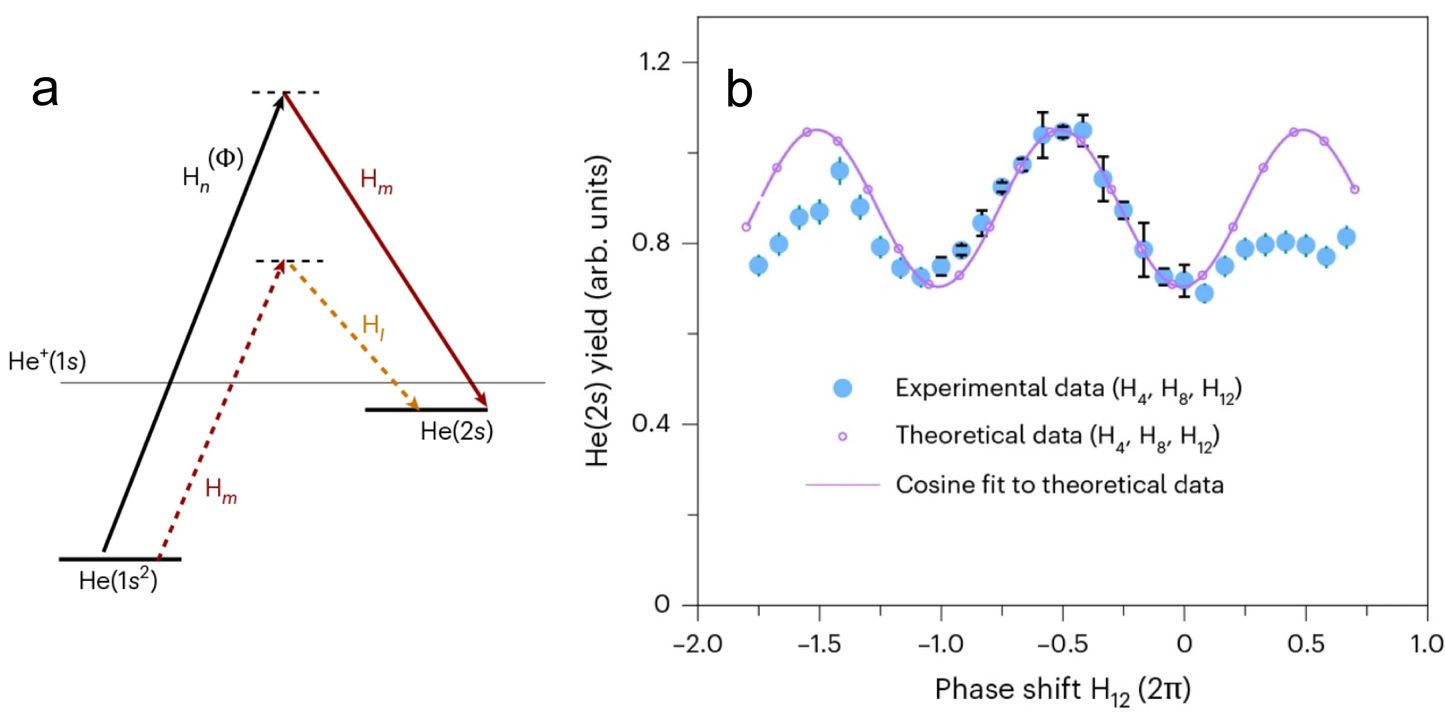
Figure 1: Interfering Raman pathways. a) Excitation scheme, which shows the two interfering stimulated Raman pathways that excite the metastable He(2s) from the ground state through the continuum. The intense and short XUV pulses used for the excitation are generated at the FERMI free-electron laser and are harmonics Hx of order x of the frequency of the seed laser. b) Excitation yield of the metastable He(2s) as a function of the phase of the harmonic Hn=12, which shows the sinusoidal behavior typical for interference. The two Raman pathways are realized by pairs of harmonics (H8, H12) and (H4, H8). Copyright: "Phase control of interfering stimulated Raman pathways in the XUV regime", U. Eichmann et al., Nature Photonics (2026), DOI: 10.1038/s41566-026-02024-9, licensed under a Creative Commons Attribution 4.0 International License.
For decades, scientists have relied on stimulated Raman scattering and related techniques using visible and infrared lasers to follow chemical reactions and electronic motion. “The new experiment demonstrates that these powerful methods can now be brought into the extreme ultraviolet, overcoming a long-standing challenge and opening new possibilities for imaging and manipulating matter with unprecedented spatial resolution”, says Ulli Eichmann, the lead author and researcher at the Max Born Institute.
The international team believes that the concepts demonstrated in this work could eventually enable a new generation of element-specific imaging and spectroscopy tools, capable of tracking electronic motion and chemical transformations at the smallest scales.
Note: the table-of-contents graphics shown in homepage and at the top-stories archive is © MBI, S. Eisebitt, AI supported.
This research was conducted by the following research team:
Ulli Eichmann1, Stefanos Carlström1, Serguei Patchkovskii1, Stefan Eisebitt1,2, Jan-Erik Rubensson3, Johan Söderström3, Jochen Mikosch4, Enrico Allaria5, Alexander Brynes5,8, Carlo Callegari5, Michele Di Fraia5,6, Michele Manfredda5, Nitish Pal5,9, Giovanni Perosa5,10, Oksana Plekan5, Alberto Simoncig5 & Matthieu Génévriez7
1 Max Born Institute, Berlin, Germany
2 Technische Universitat Berlin, Berlin, Germany
3 Department of Physics and Astronomy, Uppsala University, Uppsala, Sweden
4 Institut fur Physik, Universitat Kassel, Kassel, Germany
5 Elettra-Sincrotrone Trieste S.C.p.A., Basovizza, Trieste, Italy
6 CNR - Istituto Officina dei Materiali (IOM), Trieste, Italy
7 Institute of Condensed Matter and Nanosciences, Universite catholique de Louvain, Louvain-la-Neuve, Belgium
8 Present address: ASTeC, STFC UKRI Daresbury Laboratory and Cockcroft Institute, Daresbury Laboratory, Warrington, UK
9 Present address: Institute of Chemical Sciences, Heriot-Watt University, Edinburgh, UK
10 Present address: European XFEL GmbH, Schenefeld, Germany
Reference
Eichmann, U., Carlström, S., Patchkovskii, S. et al., "Phase control of interfering stimulated Raman pathways in the XUV regime", Nat. Photon. (2026); DOI: 10.1038/s41566-026-02024-9.
